Illness Prevention
A typical county fair brings hundreds of livestock and other domesticated animals in close proximity of people. These animals are generally healthy but occasionally may be shedding (defecating) disease-causing bacteria. Because zoonotic diseases (e.g. diseases transmitted from animals to people) – like Salmonella and E. coli – are commonly found in the feces of farm animals like cattle, sheep and goats, it’s good to take some common sense precautions to protect yourself and your family.Fairs, petting zoos and animal exhibitors also should put in place measures to reduce the potential for disease transmission. The National Association of State Public Health Veterinarians recommends that the layout and maintenance of animal exhibits is designed to reduce the risk for infection with pathogenic organisms. To reduce the risk of infection, adequate hand-washing facilities should be provided in exhibits with appropriate visitor flow between animal-contact and non-contact areas, in addition to separation between animal exhibits and food preparation or consumption areas. (NASPHV, 2013)
In its 2013 publication, the NASPHV Animal Contact Compendium Committee provides lists of guidelines and recommendations for keeping exhibitors and visitors to animal exhibits safe:
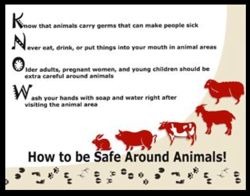
Here are some basic precautions you can take
(Excerpted and modified from NASPHV, 2013).
- Know that animals can carry germs that can make people sick
Things that Petting Zoo or Animal Exhibit Operators can do:
- Educate: Wherever there is public access to farm animals, information about the risk associated with the transmission of pathogens should be provided to all visitors. This may include signage before entering or video or audio informational pieces. For pre-arranged school visits a mailed informational sheet for parents is a good idea. An effort should be made to ensure that the visitors are aware that animals such as calves, young ruminants (i.e. sheep and goats), young poultry, and ill animals may pose a threat to human health and that appropriate hand washing can minimize that risk. Instruct visitors not to eat, drink, smoke, place hands in mouths or use bottles or pacifiers within animal contact areas.
Even the Environment can be Contaminated
Even if you do not touch the animals, the environment that the animal lives in can be contaminated by germs. This means that hand washing is still critical when visiting areas where animals reside even if you never touch the animals. This is another reason to not eat when visiting animal contact areas. Eating and food preparation should be done in separate areas, away from animals.
Visiting the Farm
 Several outbreaks have been linked to children visiting farms. Agents identified in these outbreaks include E. coli O157, Cryptosporidium, Salmonella, and Campylobacter. The risks to visitors and farm families include direct contact with animals shedding potential pathogens, contaminated environment, and consumption of contaminated products. One of the chief areas of concern has been the consumption of raw milk (i.e. unpasteurized milk). Additional information about the risks of raw milk are available at Real Raw Milk Facts.
Some general precautions for visitors and farm families include the following:
- Be aware of the potential risks
Swine influenza and County Fairs
Rare human cases of influenza viruses from swine have been reported. In recent years more cases are being reported likely due to improved diagnostic tests and clinical awareness. The majority of these are associated with swine contact. This includes interaction occupationally with swine on farms or visiting swine at county fairs. A review of cases of swine influenza identified 50 cases worldwide since the late 1960s. Some of these cases are fatal. It has been recommended that swine workers should be vaccinated with the annual seasonal influenza vaccine. In addition, folks who are ill with influenza-like symptoms should refrain from swine contact. This includes visitors to swine exhibitions such as County Fairs. Some guidelines have been recently provided by the Centers for Disease Control and Prevention.
Addendum
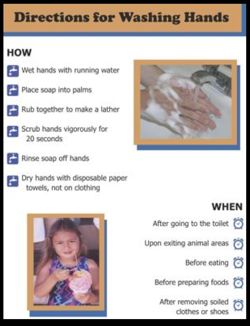
Signs and Posters for hand hygiene and recommended precautions for preventing the spread of pathogens at animal exhibits, from the National Association of Public Health Veterinarians are available online.
Also check with your State or Local Health Department.
An example of a State law
Aedin’s Law: A North Carolina law passed in honor of 2-year-old Aeden Gray of Orlando, Fla., one of 15 children whose exposure to E. coli O157:H7 at the North Carolina State Fair led to Hemolytic Uremic Syndrome and kidney failure.


